
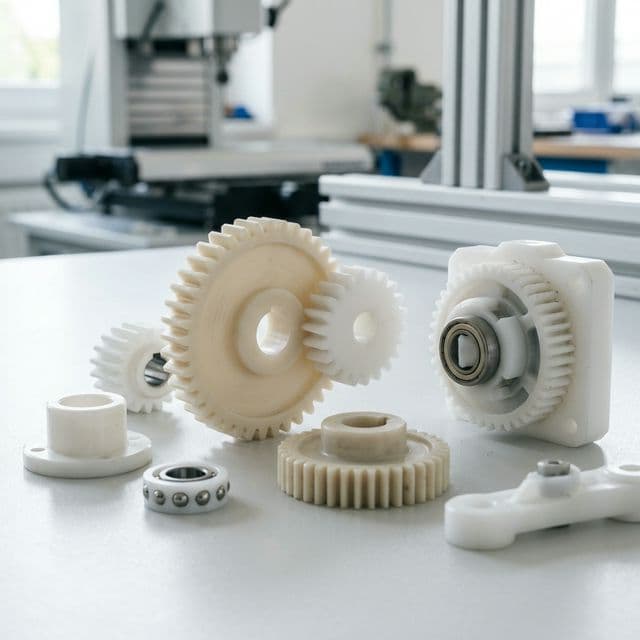
Quick answer: for fixtures and test nests in electronics, the material must protect sensitive components, hold tolerances, resist wear, and control static when needed. POM, POM ESD, PEEK, PEI, PA, and ABS can all be used, but the right choice depends on temperature, load, precision, cleaning, and contact with circuits.
What is a fixture or test nest?
An industrial fixture is a tool or support that positions a part during assembly, inspection, or testing. In electronics, test nests hold PCBs, connectors, sensors, automotive modules, or subassemblies for continuity checks, programming, machine vision, or functional testing.
The fixture material directly affects repeatability, part protection, and tooling life. A material that is too soft wears quickly; one that is too rigid or abrasive can mark components; one without ESD control can be risky around circuits.
Critical material properties
- Dimensional stability: the nest must repeat position without major changes from humidity or temperature.
- Machinability: the material must allow clean cavities, radii, pockets, and tolerances.
- Low friction: useful when parts enter and leave the fixture many times per day.
- Wear resistance: important in high-volume lines.
- ESD control: required when components are sensitive to electrostatic discharge.
- Chemical compatibility: relevant if cleaning uses alcohols, solvents, or industrial agents.
Recommended materials for fixtures
| Material | Typical fixture use | Advantage |
|---|---|---|
| POM / Acetal | Precision nests, guides, supports, and stops | Excellent balance of stiffness, low friction, and machinability |
| POM ESD | Fixtures for electronics and electrostatic-control areas | ESD control with good mechanical performance |
| PEEK | High-temperature or chemically demanding tooling | Maximum technical performance |
| PEI | Rigid components with thermal stability | Good stiffness and dimensional behavior |
| PA / Nylon | Components with impact or mechanical load | Toughness and wear resistance |
| ABS | Prototypes, covers, and lower-demand supports | Easy processing and competitive initial cost |
Why POM is common in machined nests
POM or acetal is common in fixtures because it combines dimensional stability, low friction, and clean machining. This helps produce cavities with repeatable tolerances and surfaces that do not damage the handled part.
When the fixture works with sensitive electronics, POM ESD may be more appropriate than standard POM. It keeps many of acetal’s mechanical advantages while adding electrostatic control for stations where static charge is a risk.
Design criteria to reduce failures
Control contact areas
Avoid sharp edges where the part enters or exits the fixture. Radii, chamfers, and smooth finishes reduce marks, jams, and localized wear.
Define functional tolerances
Not every dimension needs a tight tolerance. Prioritize critical references, support points, pockets, and zones related to measurement or electrical contact.
Consider cycle wear
In high-volume lines, accumulated wear can change part position. Choose materials with good wear resistance and design replaceable inserts where the contact point is critical.
Review cleaning and chemicals
If the fixture is cleaned with alcohol, solvents, or process chemicals, confirm material compatibility. PEEK, PTFE, and some POM grades may be candidates depending on the chemical and temperature.
Common mistakes when choosing fixture material
- Using aluminum in direct contact with delicate parts when a machined plastic would protect the surface better.
- Choosing ABS for an application with wear or temperature demands that require POM, PA, PEI, or PEEK.
- Ignoring ESD control at stations with PCBs or sensors.
- Not considering humidity when nylon is used in tight-tolerance parts.
- Buying material without confirming available form: plate, rod, thickness, color, or grade.
How to request a material recommendation
To quote material for fixtures or test nests, share the part type, estimated cycle count, tolerances, temperature, cleaning chemicals, whether ESD is required, and whether the material will be CNC machined. With that data it is easier to compare POM, POM ESD, PEEK, PEI, PA, or ABS without overspecifying the cost.
FAQs
What is the best material for a test nest?
There is no single best material. For precision and low friction, POM is often a good starting point. For sensitive electronics, POM ESD may be better. For high temperature or aggressive chemicals, evaluate PEEK or PEI.
Can a plastic fixture replace aluminum?
Yes, when the goal is lower weight, less risk of marking parts, electrical insulation, or better corrosion behavior. The decision depends on load, stiffness, and temperature.
Do I always need ESD material for electronics?
Not always. If the part does not contact sensitive components or the station controls risk through other means, a standard plastic may be enough. If exposed PCBs, sensors, or connectors are present, ESD should be evaluated.