
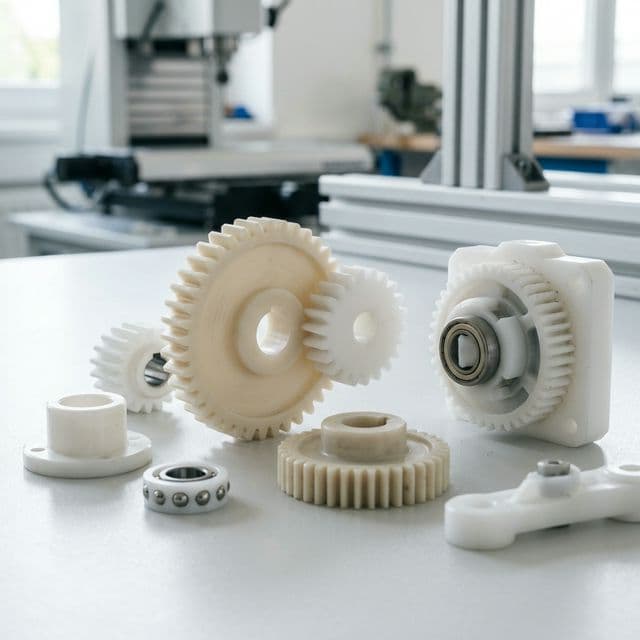
Quick answer: for gears, bushings, and moving components, POM often stands out for dimensional stability, low friction, and clean machining. Nylon or PA can be a better path when the priority is toughness, impact absorption, or load-bearing ability in certain applications. The right choice depends on humidity, tolerances, load, and operating speed.
Why Nylon and POM are compared
Both materials are used in industrial mechanical components because they combine solid performance with good machinability. But they do not fail the same way. POM is often more stable when a part needs repeatable geometry and low moisture absorption. Nylon can perform better in certain impact or load scenarios, but ambient moisture may affect its behavior.
When POM makes sense
- Precision gears and tight-tolerance parts.
- Bushings and guides where low friction matters.
- Applications with changing humidity where dimensional control matters.
- Machined parts that need clean geometry and repeatability.
When Nylon makes sense
- Parts exposed to impact or repeated mechanical load.
- Applications where toughness matters more than extreme dimensional precision.
- Projects where humidity effects are already known and controlled.
Quick comparison
| Criteria | POM | Nylon PA |
|---|---|---|
| Dimensional stability | Very good | More sensitive to humidity |
| Friction and sliding | Very favorable | Good |
| Toughness and impact | Good | Can be higher depending on grade |
| Typical use | Gears, bushings, rollers, guides | Wheels, pulleys, load-bearing parts |
Common mistakes
- Choosing Nylon without checking humidity in a tight-tolerance part.
- Choosing POM by habit without reviewing impact or load.
- Failing to distinguish a sliding part from a structural one.
- Specifying material before defining speed, load, temperature, and cycle.
Practical rule of thumb
If the component needs repeatability, low friction, and geometric control, start with POM. If the main challenge is toughness or load and humidity is controlled or irrelevant, compare Nylon. When the application is critical, review the full environment before selecting the final grade.
Share the application before you buy
To compare PA and POM with better criteria, share the drawing, estimated load, speed, humidity exposure, and operating temperature. PomDepot can help identify the right form, such as rod or plate, before machining begins.
FAQs
For gears, is POM or Nylon better?
POM is often a strong starting point for gears because of dimensional stability and low friction, but Nylon can be useful when toughness or load matters more.
Does humidity affect Nylon?
Yes. Moisture absorption can change dimensions and mechanical behavior, so it matters when the part has tight tolerances.
Is POM suitable for bushings and guides?
Yes. It is one of the most common options when smooth sliding, machinability, and repeatable geometry are needed.