
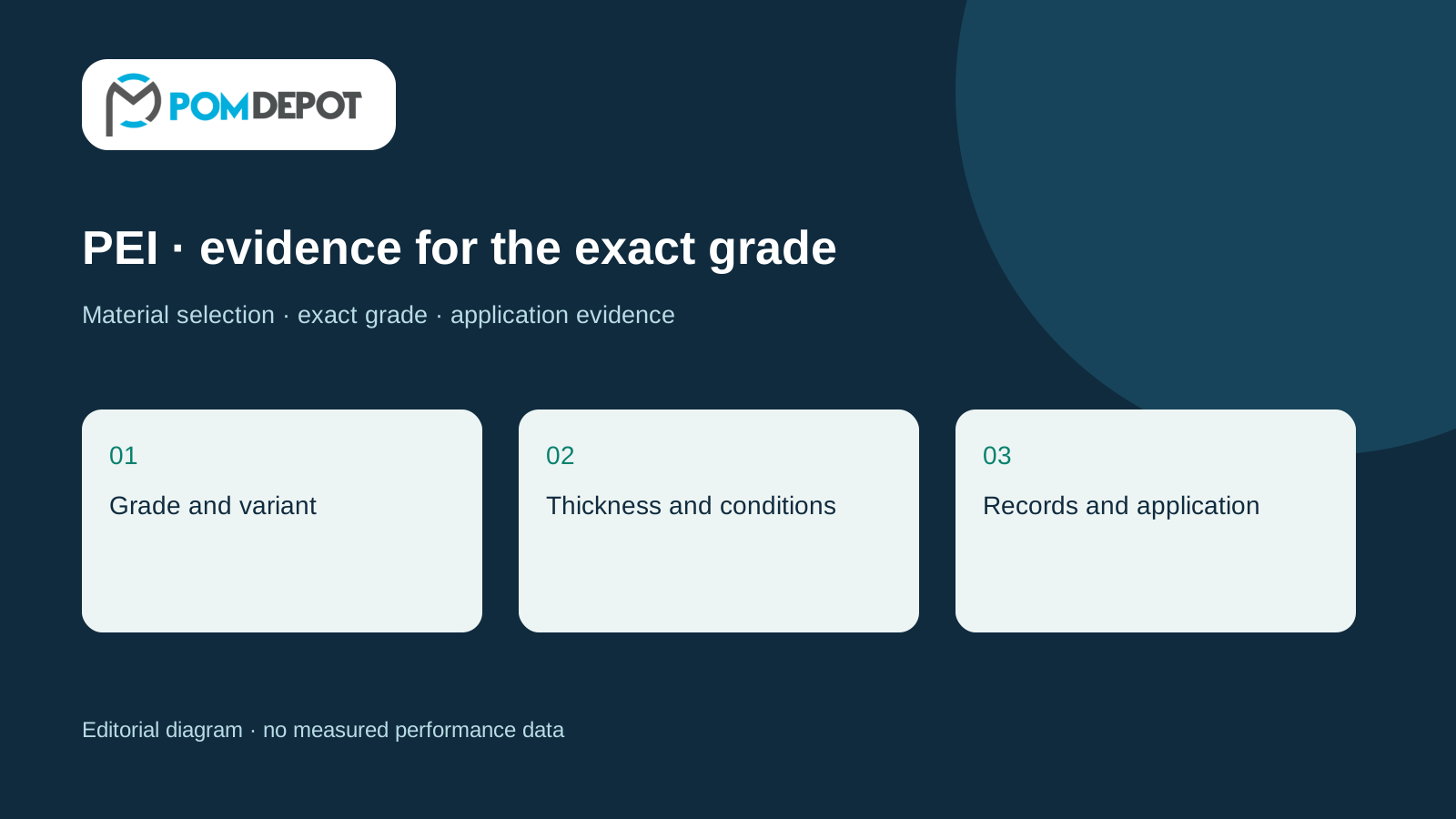
To evaluate PEI for an electrical component, request documentation for the exact grade and variant, including test conditions and the application requirement. The PEI family or ULTEM name alone cannot approve insulation, fire behaviour or a finished assembly. Material evidence needs to be related to geometry and system evaluation.
Separate polymer family, grade and supplied form
SABIC identifies ULTEM 1000 as unreinforced PEI and ULTEM 2300 as glass-fibre-reinforced PEI. They illustrate distinct formulations within one family. Consult the manufacturer’s ULTEM 1000 and ULTEM 2300 datasheets.
These references do not confirm PomDepot stock of those grades or equivalence of every PEI offer. For plate or rod, request the identity and documentation of the actual stock shape. Resin test data under defined conditions does not, by itself, certify a component with a different geometry or processing history.
Name the electrical property you require
Dielectric strength, resistivity and ESD performance answer different questions. A breakdown result under one test does not replace a resistivity requirement, and an insulating material is not automatically an electrostatic-dissipative variant. State the property and method so the response is not based on an ambiguous label.
Provide relevant conditions defined by the responsible technical team: working voltage, frequency, environment, contamination, moisture, temperature and geometry. Conductor spacing and component requirements belong to the equipment assessment; a polymer property table does not replace it. Do not extrapolate a result to another thickness or assembly without applicable evidence.
Read compliance statements within their scope
Material classification and finished-product acceptance are separate records. Where the project specifies a reference such as UL94 or another evaluation, request the current record applicable to the relevant grade, variant and thickness. Check colour restrictions and manufacturer conditions as well. The ULTEM 1000 datasheet, for example, calls for case-specific checks of certain statements for coloured variants.
A logo, generic standards list or commercial website statement is not a replacement for that record. Evidence should identify what was evaluated and the limits of the conclusion. No certification of PomDepot, its inventory or the reader’s component is asserted here.
Organise the document review
| Question | Evidence to request |
|---|---|
| What is the material? | Producer, full grade, variant/colour and supplied form |
| Which property matters? | Name, method, units and reference condition |
| What does the result represent? | Specimen, thickness, conditioning and interpretation limits |
| Which requirement applies? | Project specification and applicable record for the actual material |
| How is the part accepted? | Inspection and validation defined by the system authority |
Keep document revisions and dates. If an offer proposes another grade, record the difference and identify which evidence needs updating. Matching colour or polymer family does not close a substitution. A test temperature should also remain distinct from a sustained-service requirement.
Turn the review into a material enquiry
A useful enquiry describes the component and function, intended material or grade, form, dimensions and quantity. Attach the required documentation and identify unknowns. This lets suppliers respond against the same basis without claiming that design validation has already occurred.
Review the PEI family and send requirements through PomDepot’s contact route. Confirm the grade, form, availability and records that can actually be offered. This guide organises technical purchasing information; it does not design insulation, certify equipment or guarantee electrical performance.
Frequently asked questions
Does every PEI have the same documentation as ULTEM1000?
No. Documentation must correspond to the producer, grade, variant and supplied form. A polymer family does not transfer another formulation’s records automatically.
Is insulating PEI also an ESD grade?
Do not infer that. Define the electrical objective and request grade-specific evidence: insulation and electrostatic charge control are different requirements.
Does a material classification approve my component?
Not by itself. The project authority must assess its scope and the validation required for the actual geometry, conditions and finished product.