
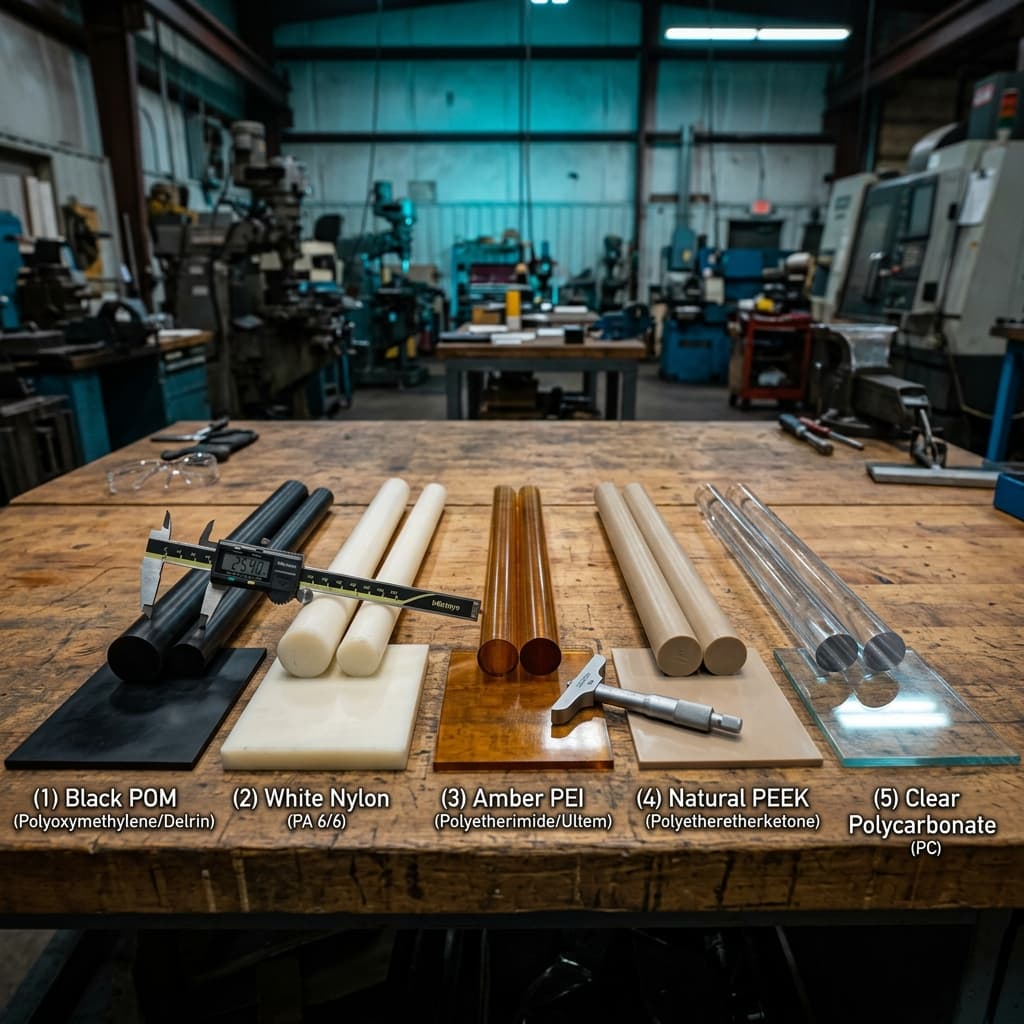
Quick answer: for precision components in packaging, guiding, or indirect product-contact applications, PET and POM are often compared because of their dimensional stability and machinability. PET can be attractive when stiffness, low moisture absorption, and repeatability are important. POM often stands out in parts with sliding or low-friction movement. If the application involves food contact, the exact grade and supplier documentation must always be verified before specifying the material.
Why PET and POM are compared
Both materials appear in packaging, food-processing, automation, and product-handling lines because they allow clean, rigid, repeatable components. But selection should not be based only on polymer name. The type of part, whether it slides, whether it contacts product, and whether the plant needs compliance documentation all matter.
When PET can be a strong option
- Precision parts with low moisture absorption requirements.
- Separators, supports, or components where stiffness matters.
- Applications where geometry must stay stable in variable environments.
When POM can be a stronger option
- Guides, bushings, and parts with sliding or friction.
- Components that need clean machining and repeated movement.
- Applications where low friction matters more than static stiffness.
What to review for food-line components
Neither color nor trade name is enough to claim food-contact suitability. The part must be reviewed together with the specific grade, available documentation, use condition, and the plant's compliance policy. In some projects the main requirement is lot traceability; in others it is supporting documentation for the selected grade. That step should not be skipped.
Practical comparison
| Criteria | PET | POM |
|---|---|---|
| Stiffness and stability | Very good | Very good |
| Sliding friction | Good | Common first reference |
| Typical use | Supports, plates, separators | Guides, bushings, sliding parts |
| Documentation review | Check by grade | Check by grade |
Common mistakes
- Assuming any PET or any POM is suitable for food contact.
- Choosing by habit without checking whether the part slides or simply supports load.
- Failing to request documentation when the plant needs it.
- Ignoring available form, such as plate, rod, or required thickness.
Ask for help defining the grade
If your line needs PET or POM for packaging, guiding, or precision parts, share the application, required form, temperature, cleaning method, and documentation needs. PomDepot can help review which material deserves to be quoted first.
FAQs
Is PET or POM better for precision?
Both can work, but PET often stands out for stiffness and low moisture absorption, while POM is usually a strong candidate when friction and sliding also matter.
Does the material name prove food-contact suitability?
No. The exact grade and supporting documentation must be checked before releasing the specification.
Is POM still a common reference for sliding parts?
Yes. In guides, bushings, and moving components, POM is often a common starting point because of its low friction.