
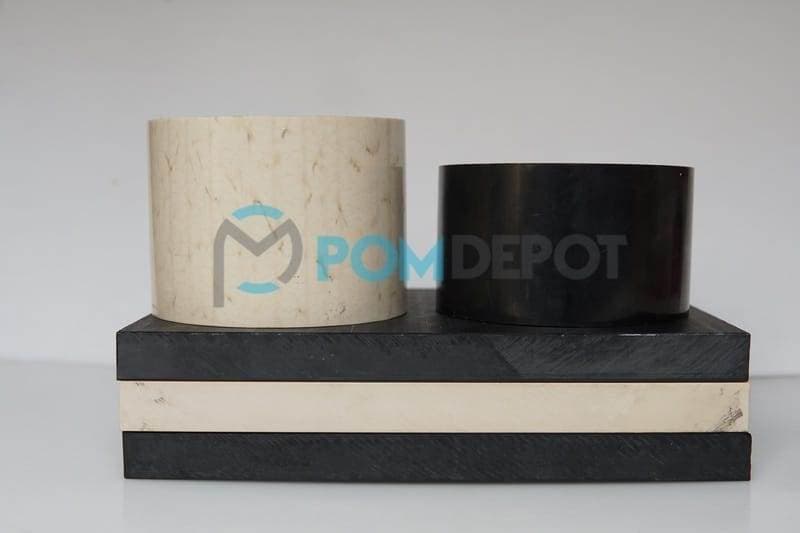
Quick answer: choose an ESD plastic when a part must control electrostatic discharge without losing mechanical performance. For most fixtures, guides, and machined parts, the practical starting point is POM ESD. If the application requires higher temperature or chemical resistance, evaluate PEEK ESD, PEI ESD, PA ESD, or ABS ESD based on the operating environment.
What is an ESD plastic?
An ESD plastic is a material formulated to dissipate or control electrostatic charge. Unlike a standard plastic, it helps reduce charge buildup that can damage electronic components, attract dust, or create failures at assembly stations.
In industrial manufacturing, ESD materials are common in test nests, guides, trays, spacers, supports, conveyor components, and handling tools. The goal is not only for the material to be “antistatic,” but also for it to keep stable electrical behavior together with stiffness, wear resistance, and machinability.
When to use ESD plastics
Use ESD plastics when the part will be near circuits, sensors, connectors, semiconductors, electronic modules, or areas where static buildup can cause product rejection. They are also useful when dust attracted by static charge affects cleanliness, machine vision, or assembly repeatability.
- Fixtures for electronic assembly and functional testing.
- Nests for PCBs, connectors, sensors, or automotive modules.
- Conveyor guides on SMT lines or inspection stations.
- Spacers and supports in electronic packaging areas.
- Machined components where metal would be heavy, corrosive, or too aggressive for the handled part.
ESD plastics comparison table
| Material | Best use | Main advantage | Consideration |
|---|---|---|---|
| POM ESD | Fixtures, guides, bushings, and precision parts | Low friction, good stiffness, and excellent machining | Not ideal for very high temperatures |
| PEEK ESD | High temperature, demanding chemistry, and critical parts | Superior performance in extreme environments | Should be justified by a real technical requirement |
| PEI ESD | Rigid components with thermal stability | Good stiffness and dimensional behavior | May be more sensitive to some chemicals than PEEK |
| PA ESD | Parts with impact, wear, and mechanical load | Mechanical strength and toughness | Humidity can affect dimensions |
| ABS ESD | Housings, covers, prototypes, and lower-load parts | Cost and ease of processing | Lower thermal and mechanical performance than POM or PEEK |
How to choose the right ESD material
1. Operating temperature
If the part works at moderate temperature, POM ESD is often a balanced option. For continuous heat, sterilization, ovens, processes near soldering, or intense thermal exposure, PEEK ESD or PEI ESD may be more suitable.
2. Wear and friction
In guides, bushings, rollers, and sliding parts, friction matters as much as electrical behavior. POM ESD usually stands out for low friction and stable CNC machining. If impact load or severe abrasion is present, PA ESD can enter the comparison.
3. Chemicals and cleaning
If the part will be exposed to solvents, oils, cleaners, or process chemicals, do not request only “antistatic plastic.” Review chemical compatibility. PEEK ESD is often the highest-performance choice, while POM ESD can work well in medium-demand industrial applications.
4. Dimensional precision
For tight tolerances, low moisture absorption, and repeatable finishes, POM ESD is usually a good candidate. Nylon or PA ESD may require more care if ambient humidity can change critical dimensions.
Common mistakes when specifying ESD plastics
- Asking only for black color: not every black plastic is ESD or conductive.
- Confusing dissipative with conductive: both control charge, but their electrical behavior is different.
- Ignoring machining: geometry, finish, and localized heat can affect final part performance.
- Not reviewing the environment: temperature, humidity, chemicals, and mechanical load change the selection.
- Choosing only by initial price: the wrong ESD part can create rejects, downtime, or damage to sensitive components.
Recommendation by application
For fixtures, guides, and precision machined parts, start with POM ESD. For high-temperature or aggressive chemical processes, compare PEEK ESD and PEI ESD. For housings or covers without high mechanical load, ABS ESD may be enough. For parts under impact or repeated stress, PA ESD can be useful if humidity is controlled.
Quote the right ESD material
If you have a drawing, sample, or specific application, share working temperature, load, chemical environment, tolerances, and expected electrical function. PomDepot can help compare POM ESD, PEEK ESD, PEI ESD, PA ESD, and ABS ESD before machining the part.
FAQs
Is every black plastic ESD?
No. Black color does not guarantee ESD properties. Confirm the material grade and its resistivity range or dissipative behavior.
When should I use POM ESD instead of PEEK ESD?
POM ESD usually works for fixtures, guides, and precision parts at moderate temperature. PEEK ESD is justified when there is high temperature, aggressive chemistry, or critical performance requirements.
Can an ESD plastic be machined?
Yes. Many ESD plastics can be machined on CNC equipment or lathes, but proper parameters are needed to avoid overheating, deformation, or finishes that compromise the part function.