
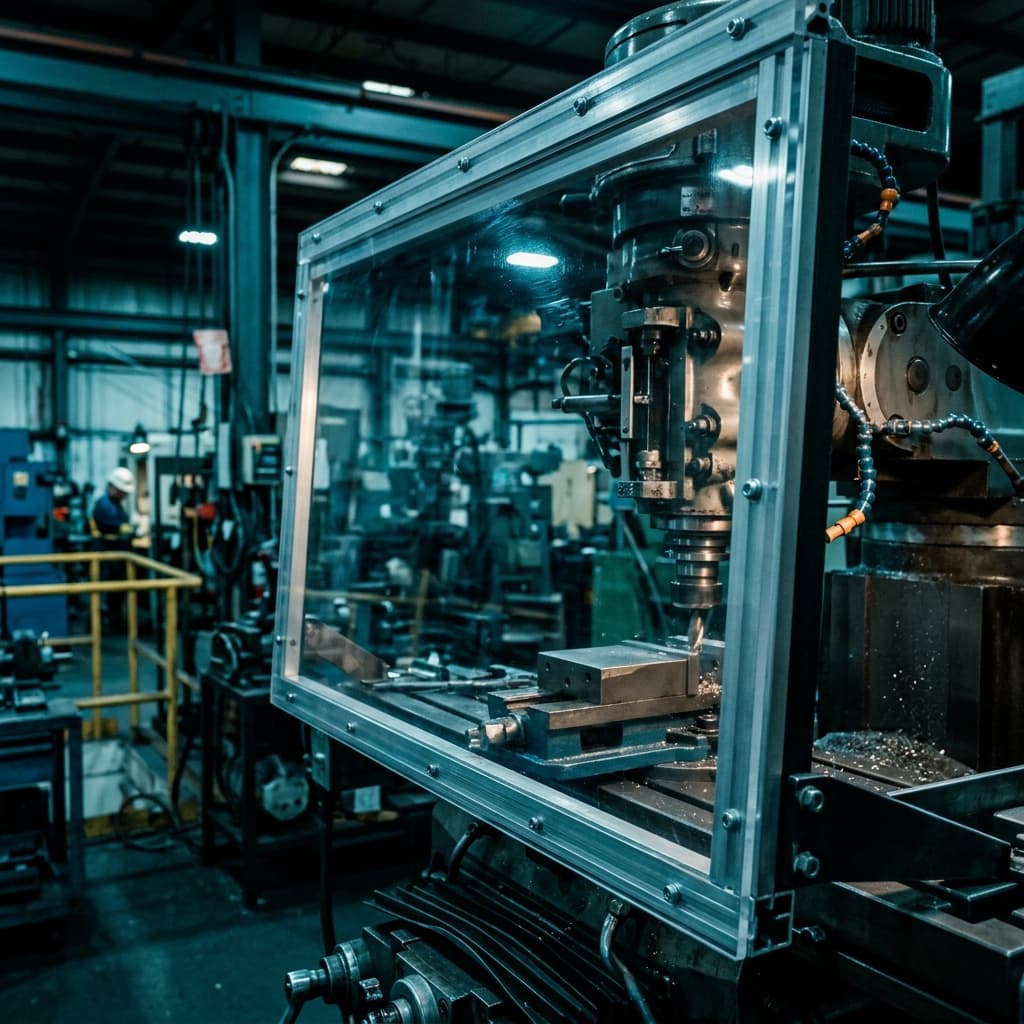
Quick answer: PC material means polycarbonate, a transparent engineering plastic known for impact resistance, dimensional stability, and usefulness in guards, covers, and industrial visual components. When someone searches for PC material or material PC, they usually want to know when polycarbonate should be chosen instead of acrylic or glass. The practical rule is simple: if the transparent part may see impact or vibration, PC usually deserves the first evaluation.
What is PC material?
PC is the technical abbreviation for polycarbonate. In industry it refers to a transparent plastic with high impact resistance, good dimensional stability, and a stronger mechanical safety margin than acrylic in many applications. When a quote says PC, it is almost always referring to polycarbonate.
Key polycarbonate properties that matter most
- High impact resistance.
- Transparency suitable for visual inspection.
- Good dimensional behavior in machined parts.
- Lower brittle-fracture risk than acrylic.
- Versatility for guards, windows, covers, and transparent supports.
PC versus acrylic and glass
| Criteria | PC / Polycarbonate | Acrylic | Glass |
|---|---|---|---|
| Impact | Very high | More brittle | Brittle |
| Transparency | High | Very high | Very high |
| Weight | Light | Light | Heavier |
| Severe industrial use | More suitable | Depends on risk | More limited |
Industrial applications of polycarbonate
- Transparent machine guards and safety barriers.
- Inspection windows on manufacturing lines.
- Safety covers and visual panels.
- Transparent components in automotive, electronics, and process equipment.
- Parts where glass would be too brittle or too heavy.
When is PC the right choice?
Polycarbonate is usually the best first route when the part needs transparency and also faces impact, vibration, frequent handling, or operator safety requirements. If the application is more visual than mechanical, acrylic may compete. That is why the correct choice depends on the real service environment, not appearance alone.
Common mistakes when specifying PC material
- Choosing only by transparency without checking impact risk.
- Confusing PC with any transparent plastic.
- Failing to define thickness, mounting, and panel size.
- Using acrylic where the part really needs a stronger mechanical safety margin.
Share your transparent-part application
If your project needs a transparent part, share the dimensions, thickness, impact risk, and actual function. PomDepot can help review whether polycarbonate, acrylic, or another option makes more sense before quoting.
FAQs
What is PC material?
PC is the abbreviation for polycarbonate, a transparent engineering plastic known for high impact resistance and good dimensional stability.
Are PC and polycarbonate the same?
Yes. In data sheets, quotes, and industrial drawings, PC is the common abbreviation for polycarbonate.
When is PC better than acrylic?
When the transparent part must resist impact, vibration, or more severe industrial use, polycarbonate is usually the safer option.