
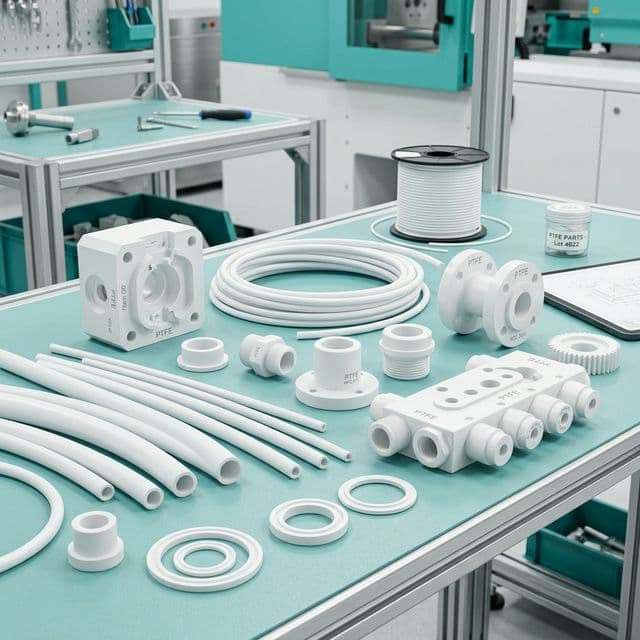
Quick answer: PTFE is a strong reference for seals, gaskets, and chemical containment parts because it combines chemical inertness with low friction. But a good buying decision still depends on temperature, pressure, geometry, and grade.
Where it fits best
- Gaskets for aggressive chemicals and corrosive media.
- Seals where low friction helps movement or assembly.
- Containment parts in process lines and lab equipment.
- Applications where cleanliness matters.
What to review before quoting
- Exact chemical media.
- Continuous temperature and peaks.
- Pressure, deformation, and duty cycle.
- Virgin versus filled PTFE.
- Final dimensions and tolerances.
Common mistakes
- Requesting “Teflon seals” without defining chemistry or pressure.
- Assuming virgin PTFE is always the best answer.
- Ignoring creep, deformation, or assembly load.
- Quoting before defining the final geometry.
Quote from the real process conditions
If the part will seal chemicals, solvents, or washdown media, share the exact fluid, pressure, temperature, dimensions, and expected cycle. PomDepot can help review whether virgin PTFE, a filled grade, or another family makes more sense.
FAQs
Why is PTFE used so often in chemical seals?
Because it combines chemical inertness with low friction in many aggressive environments.
Is virgin PTFE always the right choice?
No. Filled grades can make more sense depending on pressure, deformation, and wear requirements.
What should an industrial quote include?
The media, temperature, pressure, dimensions, and the function of the seal or gasket.