
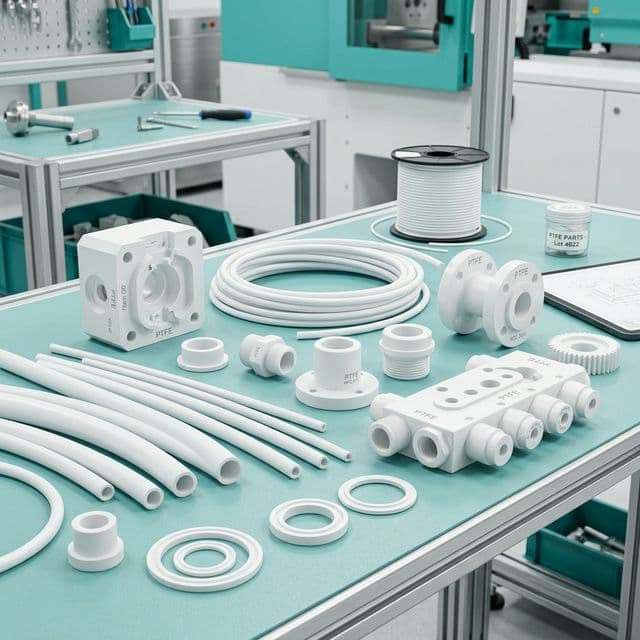
Quick answer: in industrial sourcing, PTFE is the material name; Teflon is a historical brand name associated with it. In practice, asking only for “Teflon” is not enough. The real buying decision depends on grade, fillers, geometry, chemical exposure, and temperature.
The difference that matters
PTFE is the polymer family. Teflon is a brand reference many buyers still use. The useful technical conversation starts when the quote defines virgin or filled PTFE, part form, temperature, chemistry, and function.
How to turn a generic search into a useful quote
Industrial buying gets better when “Teflon” is translated into an actual PTFE specification. That means defining whether the part is a seal, sheet, bushing, or machined component, what chemical media it will see, whether pressure is involved, and whether virgin or filled PTFE should be reviewed.
What a useful PTFE request should include
| Input | Reason |
|---|---|
| Chemical or process media | It defines actual compatibility. |
| Temperature and pressure | It affects creep and service margin. |
| Part form | It changes supply, machining, and waste. |
| Function and tolerance | It avoids vague quotes that cannot be used. |
Common mistakes
- Ordering “Teflon” without describing media, temperature, or form.
- Assuming all PTFE grades work equally well for seals and machined parts.
- Ignoring whether the application really needs low friction, chemical inertness, or both.
Quote with a clear spec
If you need sheets, rods, seals, or gaskets, share chemical media, temperature, pressure, part form, and tolerance. PomDepot can help turn a generic “Teflon” request into a workable PTFE specification.
FAQs
Are PTFE and Teflon the same thing?
PTFE is the polymer name, while Teflon is a brand reference historically associated with PTFE-based materials.
What should an industrial buyer ask for?
PTFE plus grade, part form, temperature, chemistry, and the actual function of the part.
Does the brand name guarantee the same specification?
No. Real performance comes from the technical specification, not from the word “Teflon” by itself.