
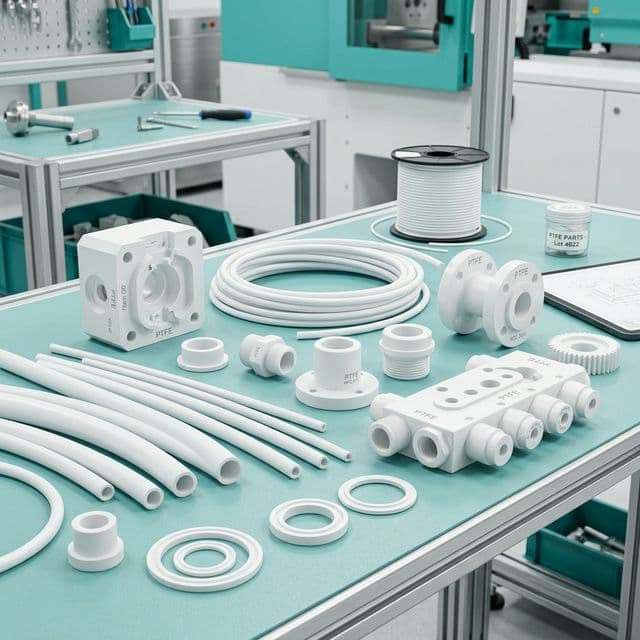
Quick answer: PTFE and UHMWPE are both low-friction materials, but they solve different problems. PTFE stands out for chemical resistance and non-stick behavior. UHMWPE is usually better when the priority is wear, impact, and abrasion resistance in guides, rails, liners, and conveying components.
What is PTFE?
PTFE means polytetrafluoroethylene. It is known for very low friction, excellent chemical resistance, and non-stick behavior. It is used in seals, gaskets, bushings, insulators, coatings, and components exposed to aggressive chemicals.
What is UHMWPE?
UHMWPE means ultra-high-molecular-weight polyethylene. It is a technical plastic with high abrasion resistance, good impact resistance, and low friction. It is common in chain guides, rails, wear plates, liners, hoppers, and industrial conveying parts.
PTFE vs UHMWPE comparison
| Criterion | PTFE | UHMWPE |
|---|---|---|
| Friction | Very low | Low |
| Chemical resistance | Excellent against many aggressive chemicals | Good, but not as broad as PTFE |
| Abrasion | Moderate depending on load and application | Very high, one of its main advantages |
| Impact | Limited compared with UHMWPE | Very good |
| Typical applications | Seals, gaskets, insulation, chemicals | Guides, rails, wear plates, conveyors |
| Best selection question | Are chemicals or non-stick behavior critical? | Is there abrasion, impact, or continuous movement? |
When to choose PTFE
Choose PTFE when the part will be exposed to aggressive chemicals, requires non-stick behavior, or must work as a seal, gasket, insulator, or low-friction surface under relatively low load. It is also useful when low surface energy is needed.
PTFE is not always the best answer for severe abrasion or impact. In those conditions, compare it with UHMWPE or other wear materials.
When to choose UHMWPE
Choose UHMWPE when the main problem is wear from friction, abrasion, or impact. It is common in conveying lines, chain guides, sliding surfaces, hoppers, and parts that receive repeated contact with product or components.
If the application also involves food contact or cleaning processes, confirm the specific grade and available documentation for the application.
Practical selection cases
Chain guide in a conveyor
UHMWPE is usually the first candidate because of wear resistance, low noise, and good sliding. PTFE may be unnecessary if there are no aggressive chemicals or critical non-stick requirements.
Gasket exposed to chemicals
PTFE is usually the better starting point because of its chemical resistance. Final selection depends on chemical, temperature, pressure, and sealing geometry.
Hopper liner
UHMWPE can work very well for abrasion and impact. If the main issue is material sticking or aggressive chemical exposure, PTFE can enter the comparison.
Low-friction bushing
The decision depends on load, speed, temperature, and environment. PTFE can provide low friction, but UHMWPE may last longer when impact or abrasion is present.
Common mistakes
- Choosing PTFE only because it has low friction when the real problem is abrasion.
- Using UHMWPE in chemicals where PTFE would be safer.
- Not considering temperature, pressure, and load.
- Ignoring the manufacturing method: plate, rod, machining, or lining.
- Comparing materials without reviewing cleaning, humidity, and operating cycles.
Quote with application data
To decide between PTFE and UHMWPE, share contact type, load, speed, temperature, chemicals, dimensions, and expected life. With that information, PomDepot can help select the right material to reduce wear, friction, or compatibility failures.
FAQs
Does PTFE have lower friction than UHMWPE?
Yes, PTFE usually has lower friction. But if the application has abrasion or impact, UHMWPE may provide better service life.
Does UHMWPE resist chemicals?
It resists many chemicals, but it does not have PTFE’s broad chemical resistance. Compatibility must be checked with the specific chemical and temperature.
Which is better for conveyors?
UHMWPE is usually better for conveyor guides, rails, and wear plates because of its abrasion and impact resistance.