
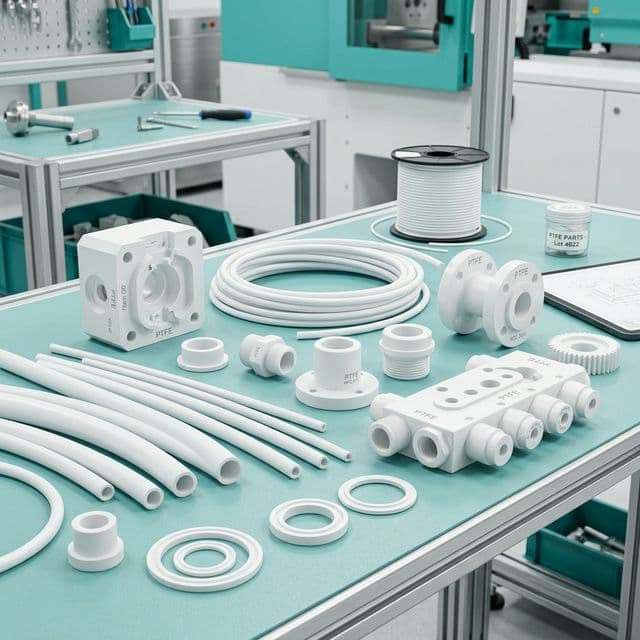
PTFE, or polytetrafluoroethylene, is a fluoropolymer commonly evaluated when an application combines low friction, chemical exposure, temperature, or electrical insulation requirements. The useful answer to “what is PTFE?” goes beyond the definition: the right choice also depends on load, motion, chemical medium, temperature, tolerances, and documentation requirements.
PTFE can be a strong starting point for selected sealing, sliding, or process-contact applications. It is not automatically the best material for every moving part. Its relatively low stiffness and behavior under sustained load mean that the design and the specific grade should be reviewed before it is specified.
What is PTFE?
PTFE means polytetrafluoroethylene. It is a semi-crystalline fluoropolymer known for very low friction, chemical resistance, a low-adhesion surface, and electrical insulation properties. In commercial conversations it may be called Teflon®, but a technical specification should identify PTFE and confirm the required grade.
Actual performance changes with formulation, stock shape, and service conditions. A material-family name does not replace a compatibility review or the technical data for the grade being quoted.
PTFE properties that matter in material selection
Low friction and low-adhesion surface
PTFE is often considered when a component must promote sliding or reduce surface adhesion. That benefit alone does not guarantee low wear. The mating surface, pressure, speed, lubrication, geometry, and operating cycles must also be reviewed.
Chemical resistance
PTFE has very high chemical resistance and is frequently considered for seals, gaskets, guides, and components exposed to demanding media. Compatibility should never be assumed broadly: confirm the exact chemical, concentration, temperature, pressure, and cleaning cycle before selecting a grade.
Temperature and electrical insulation
The PTFE family is known for thermal stability and electrical insulation properties. For an actual application, provide the continuous temperature, peak temperature, and any cycling, steam, vacuum, or process conditions. The acceptable limit must be confirmed against the specific grade documentation.
Stiffness, expansion, and sustained load
PTFE should not be selected only because of low friction. Its relative stiffness and thermal expansion deserve attention where there are tight tolerances, sustained loading, small bearing areas, or continuous motion. A filled grade or a different material family may need evaluation.
PTFE vs. POM: how to frame the decision
PTFE and POM can appear in the same material-selection discussion, but they address different priorities. This table helps identify what must be verified; it does not replace grade validation or application testing.
| Decision factor | PTFE may be a first material to evaluate when… | POM may be a first material to evaluate when… | Confirm before specification |
|---|---|---|---|
| Friction and contact | Low friction or a low-adhesion surface is important. | Mechanical motion requires rigidity and dimensional stability as key priorities. | Speed, load, mating surface, lubrication, and expected wear. |
| Chemical exposure | The chemical medium is central to the application. | The exposure is compatible with the POM grade under review. | Chemical, concentration, temperature, pressure, and cleaning process. |
| Temperature | Temperature is an important requirement and must be reviewed alongside load. | The application stays within the documented limits of the POM grade. | Continuous temperature, peaks, cycling, and tolerances. |
| Stability under load | Friction, chemistry, or temperature dominates the requirement and deformation will be validated. | Rigidity and dimensional stability are key part requirements. | Sustained load, bearing area, geometry, and allowed deformation. |
| Electrical insulation | An insulating material family must be evaluated. | Electrical performance is not the main criterion or will be assessed separately. | Voltage, frequency, environment, and applicable documentation. |
If rigidity and dimensional precision are the primary needs of a mechanical part, also review natural POM. If the application depends on chemical exposure, temperature, or low adhesion, start with PTFE material and confirm the grade before final specification.
What information is needed to select PTFE?
- The chemical or fluid, concentration, and cleaning cycles.
- Continuous temperature, peaks, and thermal changes.
- Load, contact pressure, speed, and type of motion.
- Required stock shape: rod, sheet, tube, or another starting form.
- Dimensions, tolerances, and quantity.
- Any documentation or compliance requirements that must be checked for the grade.
PTFE shapes and filled variants
PomDepot’s catalog includes PTFE forms for industrial evaluation and filled variants. A filler should not be chosen by name or color alone: the decision depends on load, wear, mating surface, chemistry, and temperature. Availability and grade documentation should be confirmed in the quotation process.
Frequently asked questions about PTFE
What is PTFE?
PTFE is the abbreviation for polytetrafluoroethylene, a fluoropolymer evaluated for low friction, chemical resistance, thermal stability, electrical insulation, and a low-adhesion surface.
Is PTFE always better than POM?
No. PTFE and POM address different priorities. PTFE may be relevant when chemistry, temperature, or low adhesion drives the decision; POM is often evaluated when rigidity and dimensional stability are especially important. The application determines the answer.
Does low friction mean PTFE will always have lower wear?
Not necessarily. Wear depends on load, speed, mating surface, lubrication, temperature, geometry, and grade. Low friction is a selection criterion, not a universal service-life guarantee.
Is PTFE automatically suitable for food-contact or medical applications?
That should not be inferred from the material family. Any contact, compliance, or critical-use requirement must be validated against the documentation for the exact grade and the application requirements.
Request a quote with the right context
To evaluate PTFE, share the chemical or fluid, temperature, load, motion, shape, dimensions, quantity, and documentation requirements. Send those details through contact to support a material quotation.