
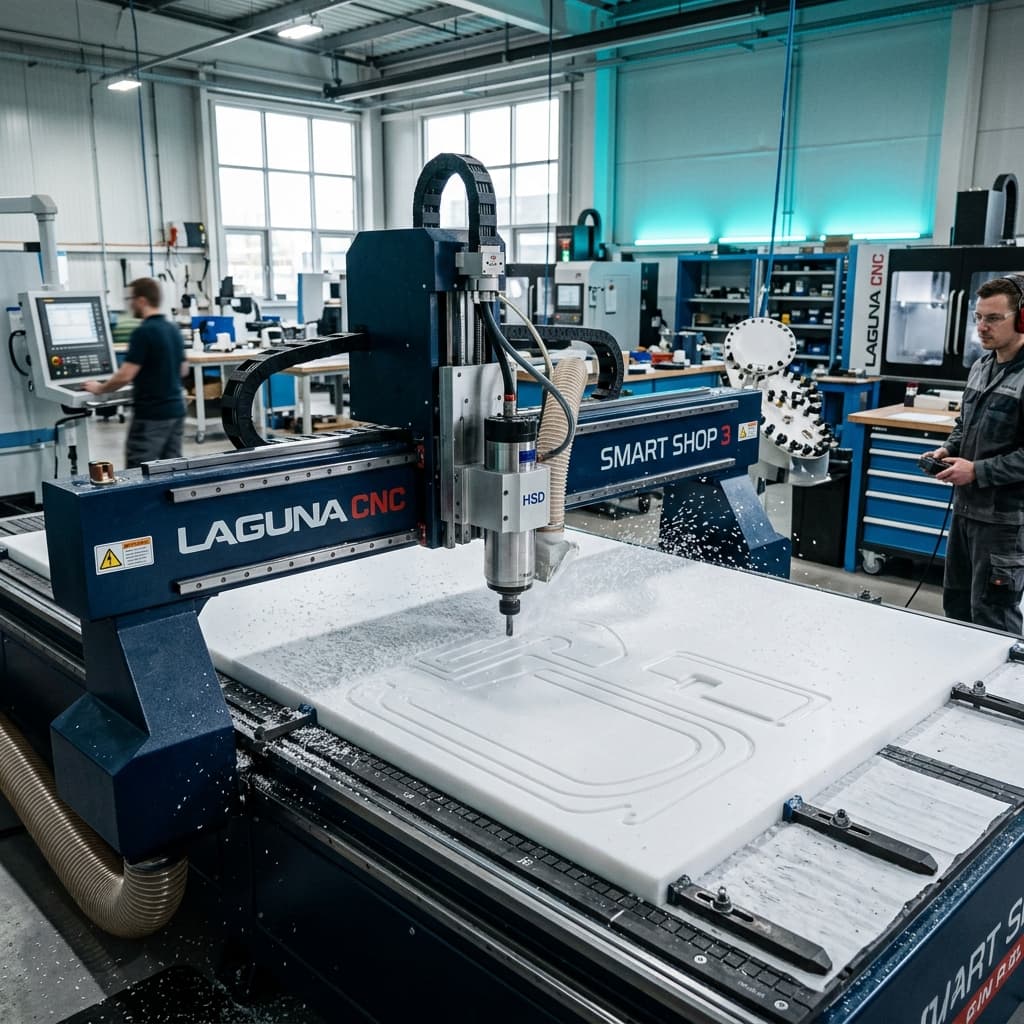
UHMWPE is an ultra-high-molecular-weight polyethylene commonly evaluated for sliding, wear, and impact applications. It should not be selected only because it is described as wear resistant: load, temperature, mating material, geometry, movement, and part dimensions determine whether a UHMWPE grade fits the job.
If you are looking at UHMWPE material for a guide, liner, or conveying component, start by defining the operating problem. That context makes it possible to compare UHMWPE with other engineering-plastic families without promising an outcome that the grade or application has not yet validated.
What is UHMWPE?
UHMWPE means ultra-high-molecular-weight polyethylene. It is a polyethylene family whose very long molecular structure is associated with useful wear, impact, and sliding behavior in many industrial applications. Actual properties vary by grade, stock shape, processing, and service conditions.
The family name does not by itself establish a temperature limit, approval, chemical compatibility, or service life. A specification should confirm the proposed grade data sheet and the conditions that matter to the application.
When UHMWPE is commonly evaluated
Wear and sliding
UHMWPE often enters the discussion where there is repeated contact, part conveyance, material flow, or a need to reduce dry sliding friction. Low friction alone does not guarantee lower wear. Contact pressure, speed, cycles, lubrication, roughness, and the mating material all matter.
Impact and material handling
For applications involving impact, vibration, or bulk-material handling, UHMWPE can be a material family to evaluate because of its impact behavior. Before deciding, define the impact energy, how the part is fixed, available thickness, and whether the piece sees sustained or concentrated load.
Environment and process media
Contact with moisture, cleaning agents, or process media needs a specific review. Describe the medium, concentration, temperature, and cycles before assuming compatibility. Any contact, hygiene, or compliance requirement must be checked against documentation for the exact grade.
UHMWPE vs. HDPE: what changes the decision
UHMWPE and HDPE belong to the polyethylene family, but they should not be treated as automatically interchangeable. UHMWPE is often evaluated when wear, impact, or sliding is central; HDPE may be a material to compare when the problem, design, and required performance are different. Start with the functional requirement, not just the polymer name.
| Factor | Selection questions | What to confirm |
|---|---|---|
| Contact and wear | Does the part guide, slide, convey, or receive abrasion? | Load, speed, mating material, lubrication, and cycles. |
| Impact | Are there blows, vibration, or falling material? | Energy, fixation, thickness, and bearing area. |
| Temperature | Are there thermal peaks or continuous operation? | Actual temperature, duration, and permitted deformation. |
| Part stability | Are tolerances or sustained load critical? | Geometry, fixation, expansion, and grade creep. |
| Process media | Are chemicals, cleaning, or moisture present? | Substance, concentration, temperature, and documentation. |
Applications that need engineering review
Wear guides, liners, rails, chutes, guards, and conveying components are examples of contexts where UHMWPE may be evaluated. Those examples are not an approval of use. The final part needs review of load, temperature, fixation, shape, and grade before it is specified.
When dimensional stability is the dominant requirement for a mechanical part, it can also make sense to compare natural POM. When an application is dominated by chemical exposure, temperature, or a low-adhesion surface, also review the PTFE guide. The comparison helps ask better questions; it does not replace material validation.
Details that make a UHMWPE quote useful
- Part function: guide, liner, rail, wear plate, or another use.
- Load, impact, speed, direction, and motion cycles.
- Continuous temperature, peaks, and operating environment.
- Mating material and whether lubrication, abrasives, or chemicals are present.
- Required stock shape, dimensions, tolerances, thickness, and quantity.
- Documentation or compliance requirements that must be confirmed for the grade.
Limitations that should not be ignored
UHMWPE is not a universal answer. Stiffness, sustained load, temperature, and dimensional stability can change the decision. If the application needs tight tolerances, a high bearing load, or demanding thermal exposure, confirm grade behavior and consider a technical comparison before ordering.
Frequently asked questions about UHMWPE
What is UHMWPE?
UHMWPE is the abbreviation for ultra-high-molecular-weight polyethylene, a polyethylene family frequently evaluated for wear, impact, and sliding in industrial applications.
Are UHMWPE and HDPE the same?
They should not be treated as automatically interchangeable. Both are polyethylenes, but selection depends on wear, impact, load, temperature, geometry, and the required grade.
Is UHMWPE always the best material for wear?
No. Wear depends on the mating material, load, speed, abrasives, lubrication, temperature, and part design. UHMWPE can be a family to evaluate, not a universal guarantee.
Is UHMWPE automatically suitable for food contact?
That should not be inferred from the material name or color. Any contact or compliance requirement must be confirmed with documentation for the exact grade and the use context.
Request a quote with the right context
To guide a UHMWPE quotation, share part function, load, motion, temperature, mating material, stock shape, dimensions, quantity, and required documentation. Send those details through contact so the material can be evaluated in application context.