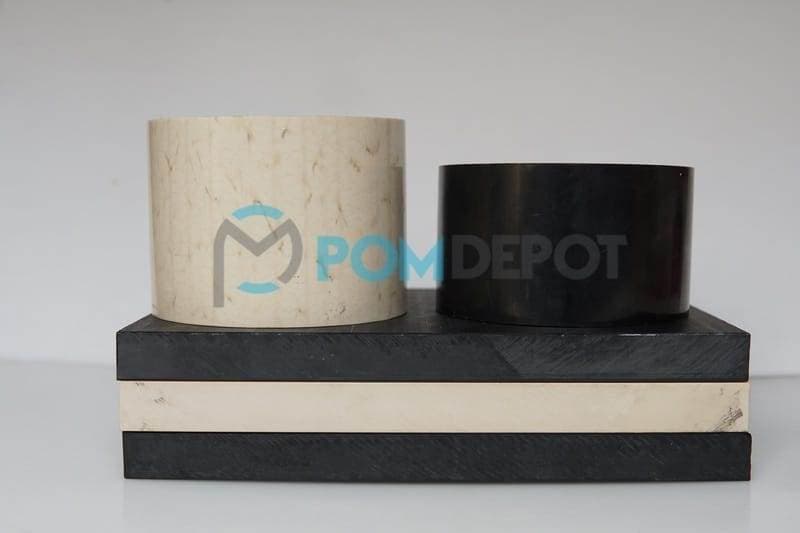
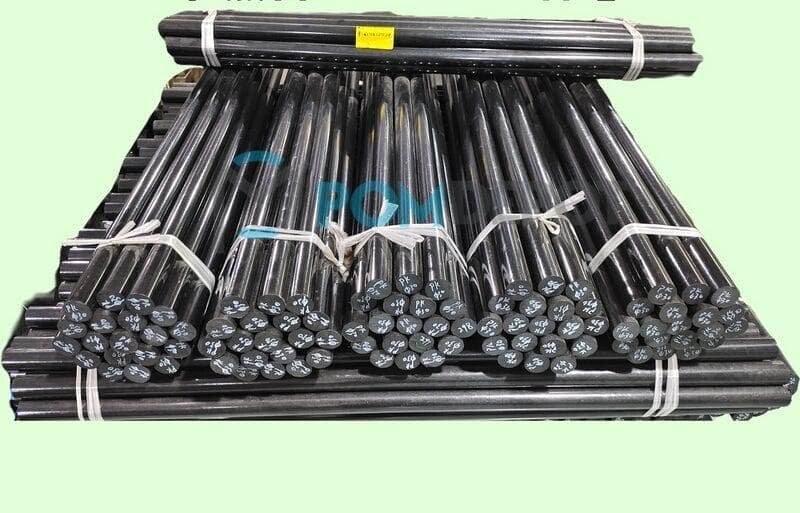
PEEK Polyetheretherketone
PEEK (polyetheretherketone) is a semi-crystalline thermoplastic used in mechanical components, insulation, and process equipment. The table distinguishes continuous service temperature from melting temperature.
Chemical resistance and mechanical properties depend on the grade and operating conditions. Medical, food-contact, and aerospace applications require specific documentation and validation; this page does not establish implant-grade suitability.
Technical Specifications
Catalog reference values. Confirm the grade, test method, and operating conditions against the supplier datasheet before specifying the material.
Features
- Material for precision machining
- Low moisture absorption
- Grade-dependent thermal and mechanical properties
Applications
Available Forms & Sizes
| Form | Dimensions | Color |
|---|---|---|
| Round rod | Ø10–200 mm × 1000 mm | Natural (beige) |
| Plate | 610 × 1220 mm, thickness 6–80 mm | Natural (beige) |
Processing & Machining Notes
The catalog describes carbide or PCD tools for PEEK and notes distortion from residual thermal stress. Annealing cycles are not interchangeable across grades and part geometries.
General catalog guidance. Cutting, cooling, and heat-treatment parameters need validation for the specific grade and part.
Standards and documentation to confirm
These catalog references do not certify every grade or batch. Request the supplied grade’s document and application scope, especially for food contact, medical use, or ESD protection.
View supporting documentsQuestions about this material
What is PEEK and what is it used for?
PEEK for machined components requiring thermal performance, chemical resistance, and dimensional stability. Selection depends on the grade and application.
What continuous service temperature does the catalog list for PEEK?
The catalog lists 260 °C for continuous service of PEEK. This is distinct from melting temperature; confirm the grade’s limit and operating conditions with the supplier.
What industries use PEEK?
PEEK is used in: Machined components, Pump and valve parts, Electrical insulation, Process equipment.
How do you machine PEEK?
The catalog describes carbide or PCD tools for PEEK and notes distortion from residual thermal stress. Annealing cycles are not interchangeable across grades and part geometries.
What documentation should I confirm for PEEK?
The catalog references: UL 94 V-0, ISO 10993, FDA (food-contact grade), ASTM F2026, RoHS, REACH. Request documentation for the supplied grade and batch, and confirm its scope before specifying the material.
What forms and sizes is PEEK available in?
PEEK is available in: Round rod, Plate. Custom dimensions available on request.
What is the density of PEEK?
The density of PEEK is 1.32 g/cm³. This value is important for calculating machined part weight.