
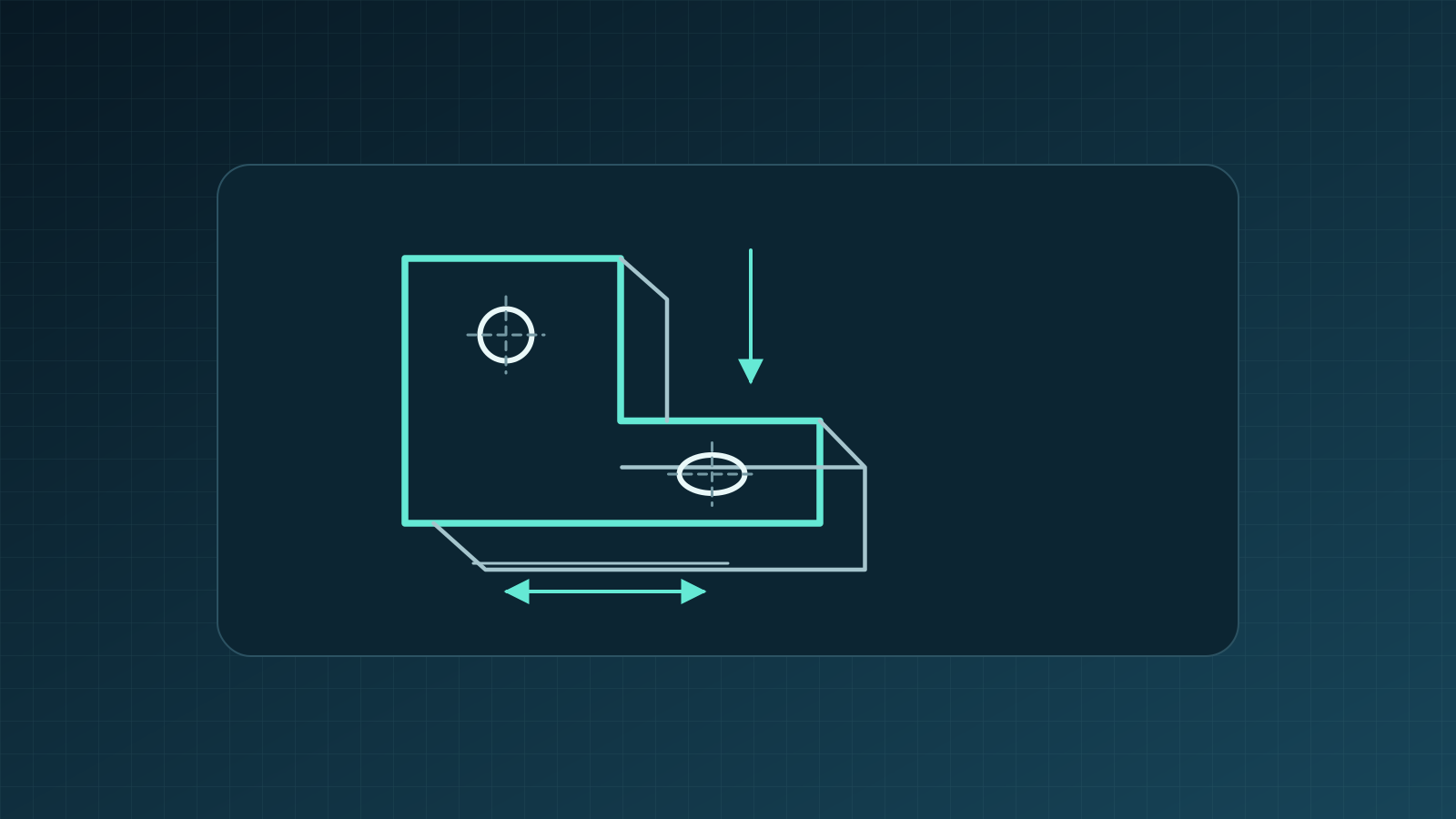
For a rigid support, consider unfilled PEI if the proposed grade meets the assembly’s limits for deflection and movement. Evaluate glass-reinforced PEI when stiffness or expansion in a particular direction drives the design. Start with the mounting points, the location of the load and the dimensions that need to hold at operating temperature.
Start with what the bracket has to do
Picture a bracket bolted to a metal base to keep a sensor aligned. The critical dimension may be the sensor position relative to that base. Record the distance from the mount to the point of load, the bracket thickness and the maximum movement the assembly can tolerate. A brief force and a load held for hours call for different evidence.
| Requirement | Useful evidence |
|---|---|
| Stiffness under load | Modulus in the relevant loading mode at the working temperature. For sustained loads, ask for creep data or define a sustained-load test. |
| Thermal movement | Expansion coefficient along the critical dimension over the relevant temperature interval. Check how the metal base and fasteners constrain movement. |
| Fit after machining | Stock shape, stock manufacturing method, orientation where documented and any thickness, flatness or hole-position tolerances. |
What ULTEM 1000 and ULTEM 2300 illustrate
SABIC identifies ULTEM 1000 as unfilled PEI and ULTEM 2300 as PEI reinforced with 30% glass fiber. Its ULTEM 2300 technical example reports expansion separately in the flow and cross-flow directions. That illustrates why you should ask for data along the axis that matters. If you are buying plate for machining, request the sheet for that stock and check the material form, direction and test method behind its values.
What to send when requesting a PEI quote
Share the exact grade or permitted alternatives, stock shape, thickness and other dimensions in millimeters, quantity and delivery city. For a potential substitution, include a mounting sketch and mark the critical dimension, temperature range and load. If the support has electrical requirements, evaluate those separately. See the guide to electrical evidence for PEI.
Check PEI in the PomDepot catalog and request a material quote. Ask which grade, shape and documentation can be provided for your required size.
Frequently asked questions
What temperature should I include if the equipment has peaks?
Give the normal temperature, the peak, its duration and where it is measured. For equipment that cycles on and off, include the cycle frequency.
What do I compare if both data sheets report modulus?
Check whether it is tensile or flexural modulus, then compare the test method, temperature and specimen orientation. Use comparable data for the design decision.
What test can help when mounting-hole position is critical?
Mount a test part with the intended fastener pattern. Record hole position or sensor alignment before, during and after the expected cycle. Set the acceptable movement first.